What is a clinical quality registry?
Clinical quality registries (CQRs) are valuable data infrastructure. In Australia, the government via the Australian Commission on the Safety and Quality of Health Care (ACSQHC) has invested in the development of CQRs via the National CQR Program, and guided by the National CQR Strategy and Framework.
In defining CQRs, the ACSQHC states that they…
“…play an important role in improving the safety and quality of healthcare by systematically collecting, analysing and reporting data on clinical care and patient outcomes. By enabling feedback loops and benchmarking to clinicians, health services and policymakers, registries provide a mechanism to identify unwarranted variation in care and support improvements in clinical practice.” ACSQHC (2026)
Eating disorders are at the top of the list for CQR investment
Eating disorders are named in the top-ranked domain in a list of priority clinical domains published by the ACSQHC (2026). This means that there is strong evidence supporting the need to develop CQRs in eating disorders based on the high level of burden eating disorders place on individuals and families and the high cost of treating eating disorders to the health system. The ranking is also partly based on the eating disorder field having demonstrated clinical leadership and readiness for a CQR through the TrEAT Registry.
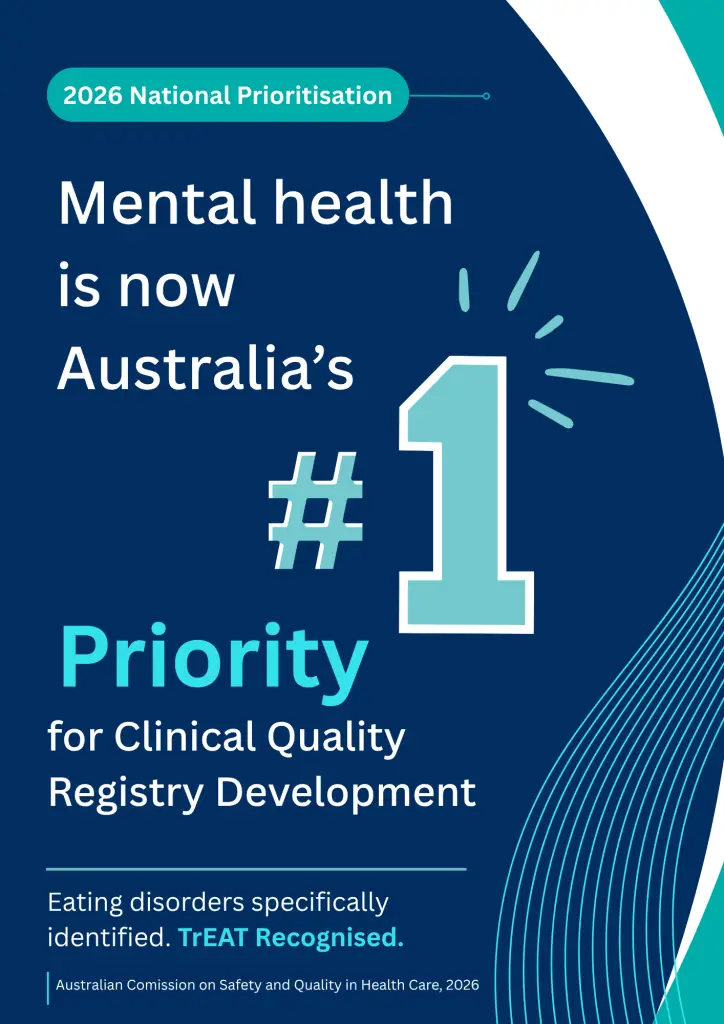
A learning health system
By supporting a continuous cycle of improvement, CQRs are considered the “backbone” of Learning Health Systems:
What is the TrEAT Registry?
The Australia and New Zealand Clinical Quality Registry for the Treatment of Eating Disorders – the TrEAT Registry – is a CQR for the eating disorders field. It is jointly owned by partner clinics and is centrally operated by a registry team.
Eating disorder services often collect information about client outcomes, even on treatment programs. But this information may be collected in different ways and is rarely pulled together for analysis. This makes it difficult to understand treatment and outcomes within clinics as well as across the wider health system.
TrEAT brings information together across clinics in a more consistent and meaningful way.
By analysing this information over time, this helps our field to answer important questions such as:
- Are people improving during treatment?
- Are there groups of people who require more or different care?
- Which parts of treatment appear to be most helpful?
- Where are there gaps or differences in access to and outcomes from care?
- Are services meeting the needs of the people they support?
- How can treatment be improved in the future?
What treatment settings are covered in TrEAT
- All eating disorders and avoidant/restrictive food intake disorder
- Outpatient, day patient, residential, and inpatient levels of care
- Public, private, or NGO operated clinics
- Child, adolescent, or adult treatment services

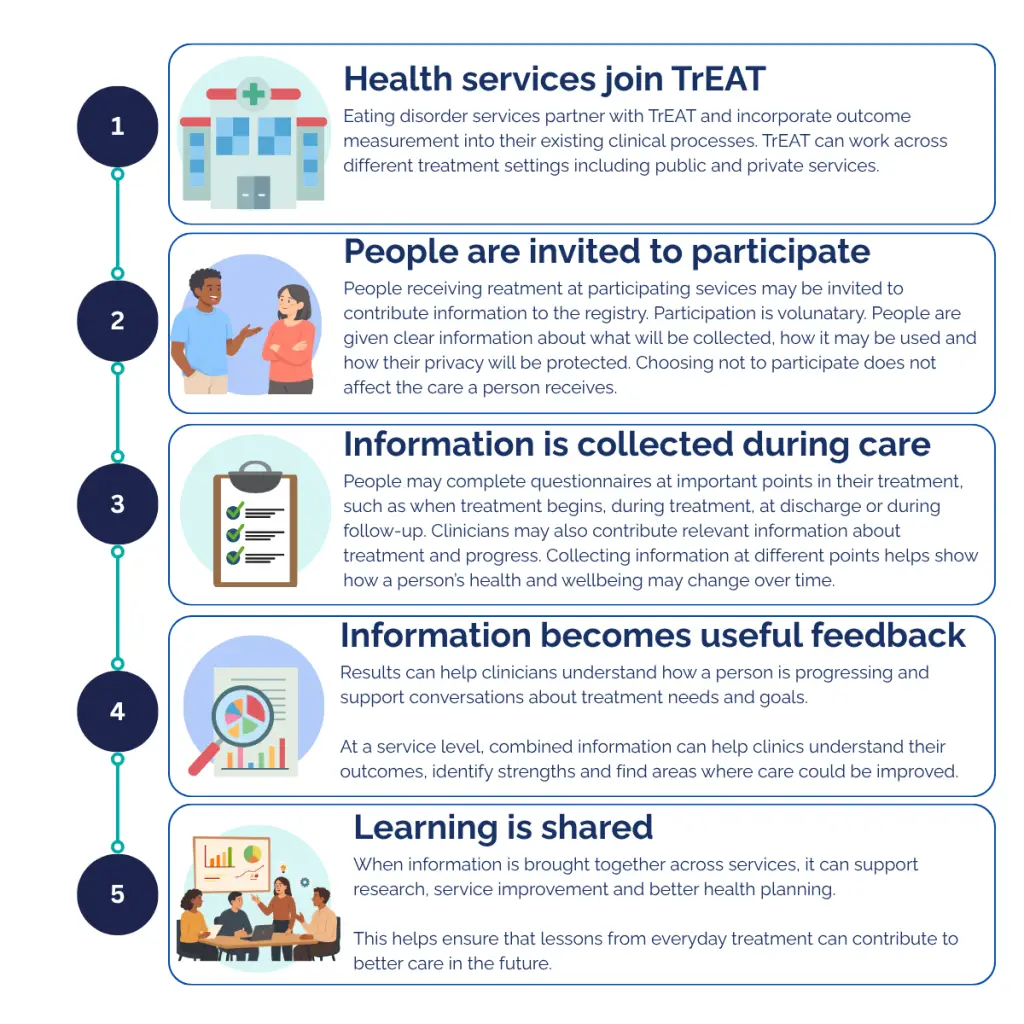
How does TrEAT work?
The TrEAT Difference
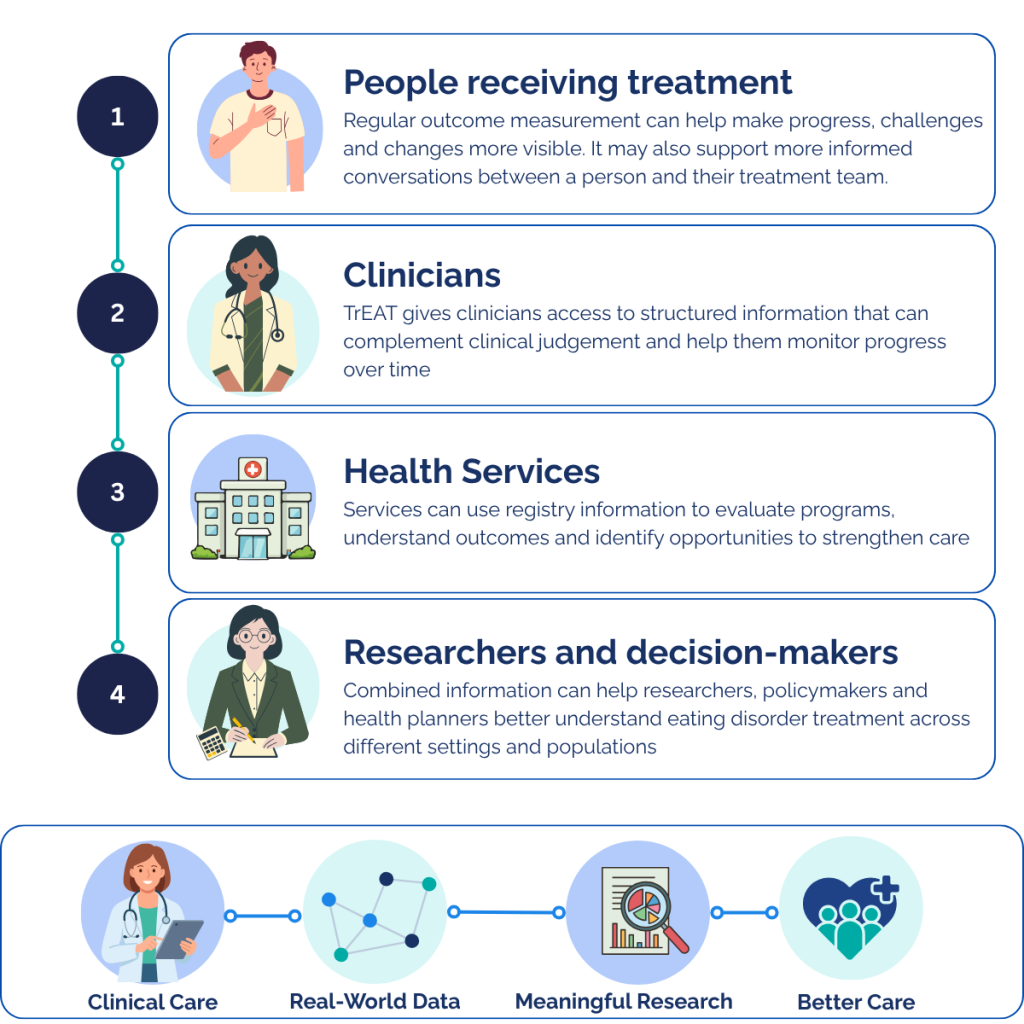
Just like other CQRs, the TrEAT Registry provides benchmarking reports to clinics to support quality improvement, and the wider de-identified dataset is used for research and to inform policy.
What makes the TrEAT Registry particularly unique among CQRs is that it has been set up to feed back treatment progress data in automated and immediately useful ways on an individual client level to support clinical decision-making during each and every episode of treatment – and not just in a grouped whole-of-clinic way on an annual basis.
A first for mental health
The TrEAT Registry is pioneering as the first CQR developed in the domain of mental health. TrEAT is formally recognised through registration on the ACSQHC Register of Clinical Registries (#ACSQHC-ARCR-279) and aligns with the National CQR Framework.
Value-add with every new clinic
The more clinics that participate in TrEAT, the clearer and more representative the picture we can paint of current needs to support future directions in our field. TrEAT is more than a data-collection machine, it is a community of practice that supports learning and mentoring by harnessing the deep level of expertise that exists across our partners.
Every clinic, no matter how big or small, makes a significant contribution to our shared mission…
…to support better treatment, stronger services and improved outcomes for people affected by eating disorders.

Who benefits from TrEAT?
The role of lived experience
Lived experience involvement is essential to ensure that TrEAT remains connected to the priorities of the people it is intended to serve.
Lived and living experience bring insights that cannot be gained from clinical or research expertise alone.
People with lived experience of eating disorders and carers are embedded in TrEAT decision-making through leadership roles in our governance teams, grants, and research publications. Their perspectives help us to understand which outcomes matter, what meaningful improvement looks like and how information should be collected and communicated.
What TrEAT does not do
TrEAT is not a treatment service and does not provide individual medical or psychological advice.
It does not replace clinical judgement, prescribe a particular treatment, or make decisions about a person’s care.
Registry information is one source of knowledge. It should always be considered alongside lived experience, clinical expertise and each person’s individual circumstances.
Building a stronger future for eating disorder care together