
Seeing the full picture: A better way to measure body image disturbance
Body image disturbance is a central feature of many eating disorders, but it can look very different from one person to the next.
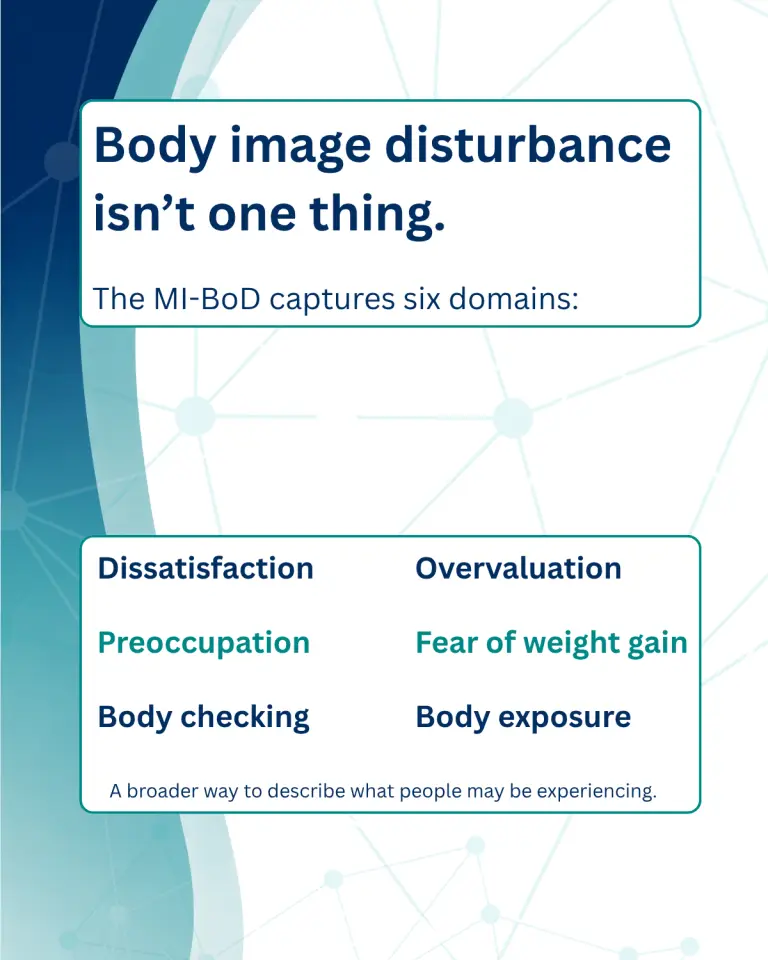
For one person, it might involve intense dissatisfaction with their body. For another, it may be constant preoccupation with shape or weight, fear of weight gain, repeated body checking or avoiding situations where their body might be seen. Yet many traditional measures have treated body image disturbance more narrowly, often focusing heavily on dissatisfaction or the desire for a thinner body.
The Multifaceted Instrument for Body Image Disturbance (MI-BoD) was developed to capture more of this complexity.
Led by Dr Katarina Prnjak, alongside Deborah Mitchison, Scott Griffiths and Phillipa Hay, the MI-BoD was designed to assess body image disturbance across gender, body size and eating disorder symptomatology. Importantly, lived experience was embedded in its development, with people with eating disorder lived experience contributing to the generation and refinement of questionnaire items alongside international experts in the field.
Measuring more than dissatisfaction
The resulting 20-item measure assesses six distinct aspects of body image disturbance:
Body dissatisfaction, overvaluation, preoccupation, fear of weight gain, body checking and body exposure.
This allows researchers and clinicians to look beyond a single overall body image score and better understand how body image disturbance is presenting for an individual.
Initial research involving university students, adolescents and people reporting an eating disorder diagnosis found promising evidence for the MI-BoD’s reliability and validity. The measure also performed consistently across gender, weight status and eating disorder symptomatology for most items.

Taking MI-BoD into real-world eating disorder care
Now, data from the TrEAT Registry are helping take that validation a step further.
A new study led by Dr Prnjak examined MI-BoD responses from 347 people with a confirmed eating disorder diagnosis receiving treatment at private clinics across Australia and Aotearoa New Zealand.
The findings supported the MI-BoD’s six-part structure, with all six subscales demonstrating excellent internal consistency. Scores also showed strong relationships with corresponding measures of body image disturbance, providing further evidence that the MI-BoD can reliably capture these different experiences within a clinical eating disorder population.
For TrEAT, this is also an example of what a clinical quality registry can make possible. By bringing together real-world data from people receiving eating disorder treatment, registry data can help evaluate the tools we use, strengthen the evidence behind them and ultimately improve how outcomes are understood and monitored in everyday care.
Rather than asking simply “Has body image improved?”, measures like the MI-BoD may allow us to ask a more useful question:
“What has changed, and what still needs attention?”
Dr Katarina Prnjak is presenting the latest clinical validation of the MI-BoD at the 2026 ANZAED Conference.